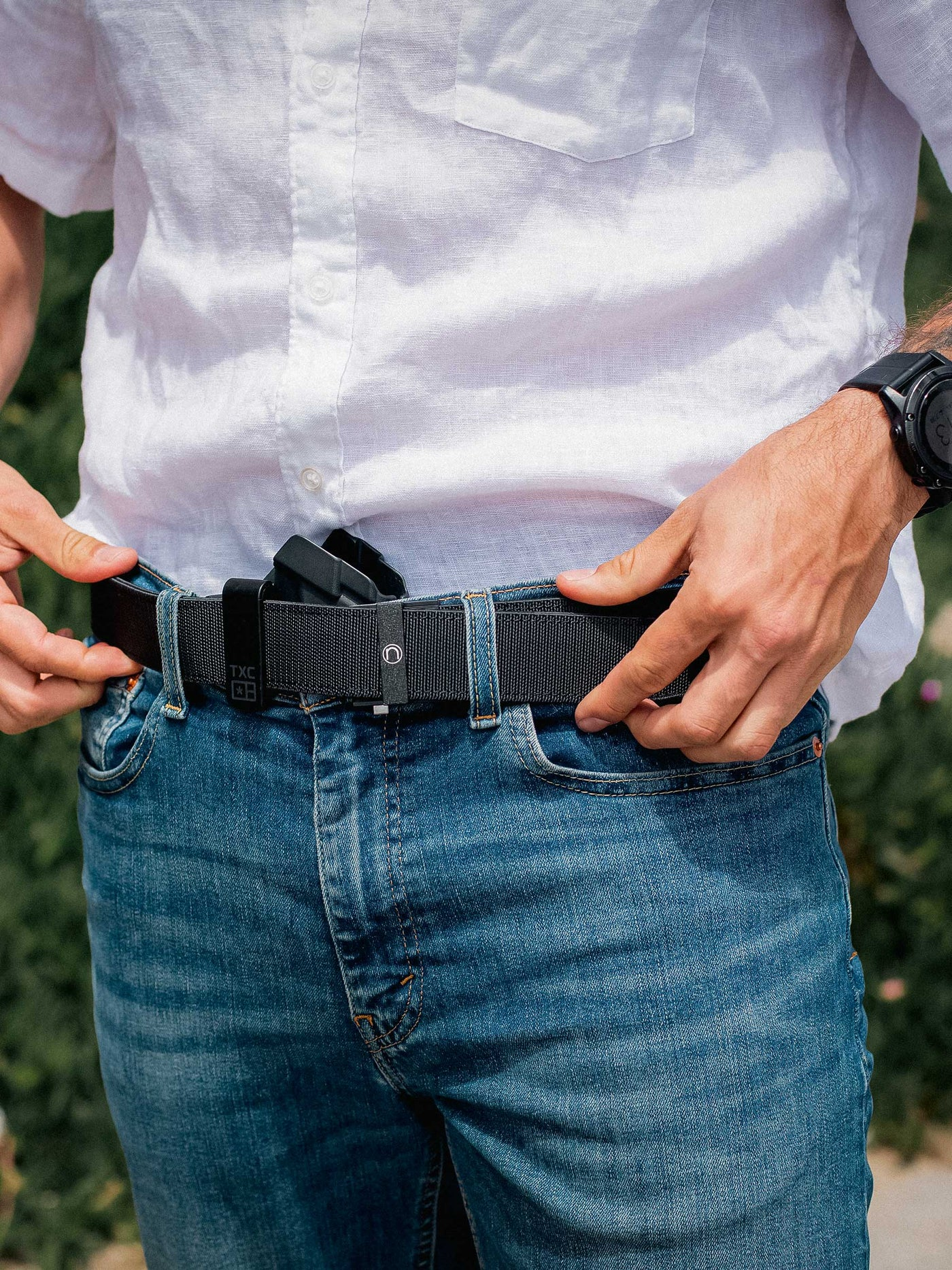

How tight should a belt actually be?
A belt should hold your pants where they belong and feel comfortable all day long. Too loose and your trousers sag. Too tight and you get uncomfortable, restricted, and in some cases you may be adding pressure to your abdomen that can affect digestion and breathing. We design our ratchet belts to make finding the perfect fit simple and repeatable, but the right tightness still comes down to a few practical rules you can follow every morning.

Start with where the belt should sit
First, place the belt where you normally wear it. For most people that means at the waistline of your pants near the belt loops. For some styles and activities the belt sits a little lower on the hips. The fit changes depending on how you carry your gear and what you do that day. If you carry concealed or wear heavier pockets, allow a little more room when you fasten it. Our sizing guidance recommends starting points and how to trim a ratchet strap so the belt fastens in the right area every time.
The practical one-finger test
A reliable, repeatable test for tightness is simple. Fasten the belt and try to slide one finger, flat, between your body and the belt. If one finger fits comfortably without force, the belt is in a good range for everyday wear. If you can push in two fingers with room to spare the belt is probably too loose. If you cannot fit a finger under the belt or you feel pinching you are too tight.
This “one finger” check gives you a quick sense of comfort while still keeping pants secure. It also makes it easy to fine tune micro-adjustments if your belt has them. Many ratchet systems, including ours, allow quarter-inch incremental changes so you can find the sweet spot and keep it there.
Why small adjustments matter
A pair of trousers that fits differently from one day to the next will make a fixed-hole belt feel wrong most days. That is the advantage of a ratchet belt. The micro-adjustments let you tighten or loosen a little bit without fighting stretched holes or gaps. If you sit for long stretches you may want to loosen one or two clicks to avoid pressure on your abdomen. If you are active or bending and want security, tighten one click. Little changes add up to big comfort gains over the course of a day.
Health and comfort: why “too tight” goes beyond annoyance
Beyond comfort, there are real physiological reasons to avoid an overly tight belt. Tight clothing and waist compression can increase abdominal pressure and worsen symptoms like heartburn and acid reflux. Clinical guidance on reflux advises avoiding tight garments that squeeze the stomach area. A study published in a gastroenterology journal found abdominal compression by a waist belt may aggravate reflux by impairing esophageal clearance. If you already have reflux or digestive sensitivity, err on the side of a slightly looser fit after meals.
Tight garments can also make diaphragmatic breathing harder. Research shows restrictive clothing reduces inhalation volume. If you feel shallow breathing, chest tightness, or numbness after tightening your belt, loosen it and allow your diaphragm to expand naturally. Comfort and performance both benefit when you let your core move freely.
Fit by activity: adjust for purpose
-
Everyday carry and daily wear: Aim for the one-finger test. If you regularly sit at a desk loosen one or two clicks while seated and tighten before standing. For concealed carry allow a bit more room on the initial fit so your firearm and holster sit comfortably. Nexbelt sizing suggests starting with your pant size plus four inches for EDC and carry setups to give enough material for IWB or OWB configurations.
-
Golf and athletic motion: You want security without restriction. Fasten the belt so it keeps your pants stable during the swing but does not pull on your ribs when you rotate. A slight loosen on the green often feels better than locking it down tight.
-
Dress and formal: A clean silhouette matters. Fasten snug enough that the belt lies flat and the buckle sits centered. If you feel pinching when you sit, loosen one micro-step so your jacket sits naturally over the waistline.
Common mistakes and how to avoid them
Mistake: Setting the belt while bending or with heavy clothing on. If you measure or tighten your belt while hunched over you will end up tighter than intended once you stand.
Fix: Stand straight and breathe normally while you fasten the belt. Do the one-finger test and then sit down to see how the fit feels while seated.
Mistake: Relying on pant size alone. Not all pants are cut the same and your body changes over time.
Fix: Use the belt’s scaling system or trimming guide to lock in a starting length, then fine tune with the ratchet. If your belt has a removable buckle, trimming the strap to your most common fit keeps the buckle and strap centered.
Mistake: Ignoring material. Thin belts and braided styles can compress differently than thick, structured leather.
Fix: Pay attention to how each material settles. Leather often molds and firms over time while braided and web belts flex. Adjust your tightness accordingly.
How to test your fit over time
-
Morning check: Fasten and do the one-finger test. If you plan to eat a big lunch or wear a suit jacket fasten a touch looser.
-
Midday check: If you feel pressure, marks, or numbness it is time to loosen a click or two.
-
Night check: When you remove the belt look for deep red marks or creases. Those are indicators you wore the belt too tightly for too long.
Small, sensible adjustments keep you comfortable and avoid the potential health downsides of long term abdominal compression. Trusted health sites advise choosing loose clothing when possible to reduce reflux and similar problems.
Why a precision system makes the difference
Belt technology that lets you make quarter-inch adjustments removes guesswork. You get to dial in a fit that holds, breathes, and moves with you. That precision matters because comfort is not one size fits all. Once you find the position that passes the one-finger test and feels secure when you move, the ratchet system locks you there until you choose to change it. If you ever need to trim a strap for a cleaner fit, follow the easy steps that come with your belt so the buckle sits centered and the strap is the correct length.
Final checklist before you walk out the door
-
Fasten standing upright.
-
Use the one-finger rule for comfort.
-
Loosen a click before sitting for long stretches.
-
Allow extra room if carrying heavy items or a firearm.
-
Reassess if you feel heartburn, shallow breathing, numbness, or deep red marks.
Ready to feel the right fit?
A belt should be invisible in the best way. It should hold, move, and let you forget it exists until you need it. If you want a system built for precision and comfort, try a ratchet belt and use the simple one-finger check to dial in your day-to-day fit. Shop styles built for daily carry, golf, and dress and find the one designed to fit how you live.

Written by Pod5 National Positions